In our first three articles, we examined how USVs extend maritime intelligence through ISR and SIGINT, how they strengthen Maritime Situational Awareness (MSA) and the Common Operational Picture (COP), and how they protect Critical Undersea Infrastructure (CUI).
Recent incidents in Denmark—where airports were disrupted by suspected drone launches from nearby vessels—have shown that hybrid threats are evolving. This article explores how USVs can shadow suspect vessels throughout their passage in Danish waters and monitor for both airborne and subsurface drone activity.
Shadowing Vessels in Transit
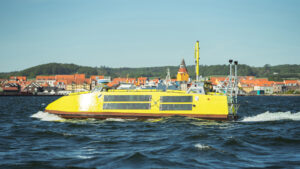
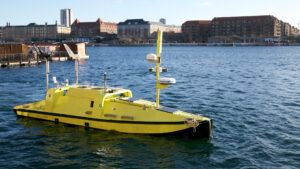
Suspect vessels, including sanctioned tankers, intelligence-gathering “research” ships, or bulk carriers with opaque ownership, routinely pass through narrow straits such as Øresund and Storebælt. Operating under “innocent passage,” they cannot easily be intercepted, but their activities must be monitored. USVs provide a persistent and discreet shadowing capability: – Full route coverage from Skagen to Bornholm (≈250–377 nm). – Safe standoff distance while maintaining continuous tracking. – Autonomous maneuvering to mirror course and speed changes. – No crew exposed to risk.
Multi-Domain Sensor Suite
Surface Awareness
– EO/IR cameras for 24/7 visual and thermal documentation. – Marine radar and AIS receivers to track vessels, even “dark ships.”
Airspace Monitoring
– Compact counter-UAV radar for small drone detection. – RF scanners to capture control/telemetry signals. – IR/optical sensors to identify drone launch events.
Underwater Surveillance
– Hull-mounted or towed sonar to detect UUVs, divers, or anomalies near subsea cables. – Passive hydrophones to capture acoustic signatures of underwater activity.
*By combining these layers, USVs close surveillance gaps across all domains: surface, air, and subsea.*
Operational Use Case
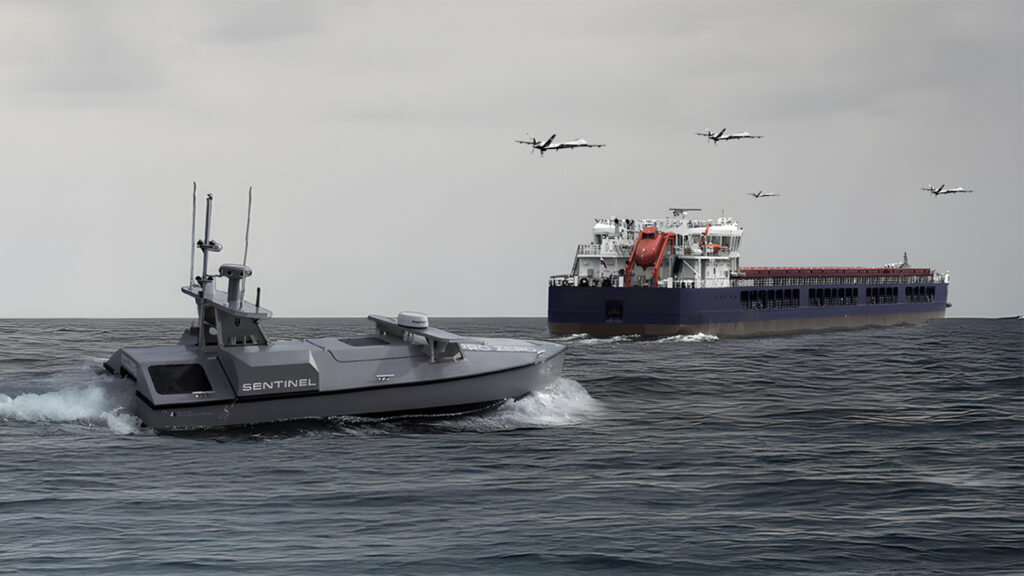
Scenario: A sanctioned bulk carrier approaches Danish waters, suspected of preparing drone operations. 1. Deployment: A ProZero USV launches ahead of the target. 2. Shadowing: Maintains safe offset, logging AIS behavior and unusual deck activity. 3. Air Monitoring: Detects and records UAV launches with radar, RF, and EO/IR sensors. 4. Subsea Scanning: Sonar sweeps reveal any underwater deployments. 5. Real-Time Relay: All data streams to command centers, enhancing the COP and enabling rapid response.
Advantages of USV Shadowing
– Persistent Coverage: 24/7 surveillance across entire transit routes. – Reduced Risk: No crew in harm’s way. – Multi-Domain Awareness: Integrated monitoring of surface, air, and subsurface. – Scalability: Deploy multiple USVs to cover larger areas or several vessels. – Interoperability: Seamless integration with naval, coast guard, and allied COP systems.
Conclusion
Hybrid threats at sea are real, immediate, and disruptive. Recent events highlight the need to detect and document suspicious activity—whether airborne, surface-based, or underwater. By deploying ProZero USVs, authorities gain a force multiplier: autonomous platforms capable of shadowing suspect vessels, identifying drone launches, and delivering actionable intelligence without risking personnel. USVs are now an indispensable tool for safeguarding maritime security against hybrid threats in the world’s busiest and most vulnerable waters.